
Language Requirements for Studying in Germany: Complete Guide to German and English Proficiency for University Admission
Studying in Germany requires meeting specific language requirements because universities and visa authorities use language proficiency to assess your readiness for academic study and daily life. This guide explains CEFR levels, compares major German and English tests, outlines Studienkolleg and preparatory course pathways, and clarifies exemptions and conditional admission so you can plan timelines and documentation effectively. You will learn which certificates most universities accept, typical minimum scores for English-taught and German-taught programs, realistic time estimates from common starting levels, and how language evidence affects visa and residence permit steps. Practical checklists, comparison tables, and pathway examples will help you pick the right test and training plan. If you need personalized planning, StudyInFocus, an educational agency based in Munich, offers a Comprehensive Admission Program that includes tailored language assessment, placement into preparatory courses, and application support — book a consultation to review your individual pathway and required documents.
What Are the German Language Proficiency Levels Required for University Admission?
German language proficiency for university admission is measured by the CEFR (A1–C2), and admissions officials typically require abilities that enable comprehension of lectures, academic reading, writing, and class participation. For most German-taught bachelor's and many master's programs, universities expect at least B2 or C1 competence because these levels correspond to independent and advanced academic language use. Program-level variation is common: humanities and social sciences often demand stronger writing and reading skills (C1), while some STEM programs may accept B2 with additional academic support. Understanding the CEFR descriptors helps you choose the right target test and preparation timeline, and the next subsection explains what each CEFR level means for academic readiness.
How Does the CEFR Framework Define German Language Levels from A1 to C2?
The CEFR divides ability into six levels from basic (A1) to near-native (C2); each level describes specific communicative competences relevant to study. A1–A2 cover everyday survival language, including simple phrases and basic interactions; students at these levels cannot reliably follow lectures or produce academic texts. B1 indicates functional independence — handling routine academic tasks and participating in seminars with support. B2 marks independent use: reading subject literature and following lectures with some technical vocabulary comprehension. C1 denotes advanced academic readiness: producing clear, well-structured academic texts and understanding complex lectures; C2 approaches near-native fluency. These descriptors map directly to test expectations and help set realistic preparation goals for university study.
Which CEFR Levels Are Required for German-Taught Degree Programs?
Universities generally list B2 or C1 as minimums for German-taught programs, with many public universities expecting C1 for humanities and teacher training because of the heavier emphasis on academic writing and discourse. Bachelor's programs often require B2 for STEM subjects but may ask for C1 for programs involving law, literature, or advanced seminars. Master's programs can range from B2 (for professionally oriented technical programs) to C1 (for research-oriented or language-heavy disciplines). Some institutions offer conditional admission tied to language courses if applicants meet academic prerequisites but lack the required CEFR level; the following section compares accepted certificates and how they map to these CEFR expectations.
Which German Language Certificates Are Accepted by German Universities?
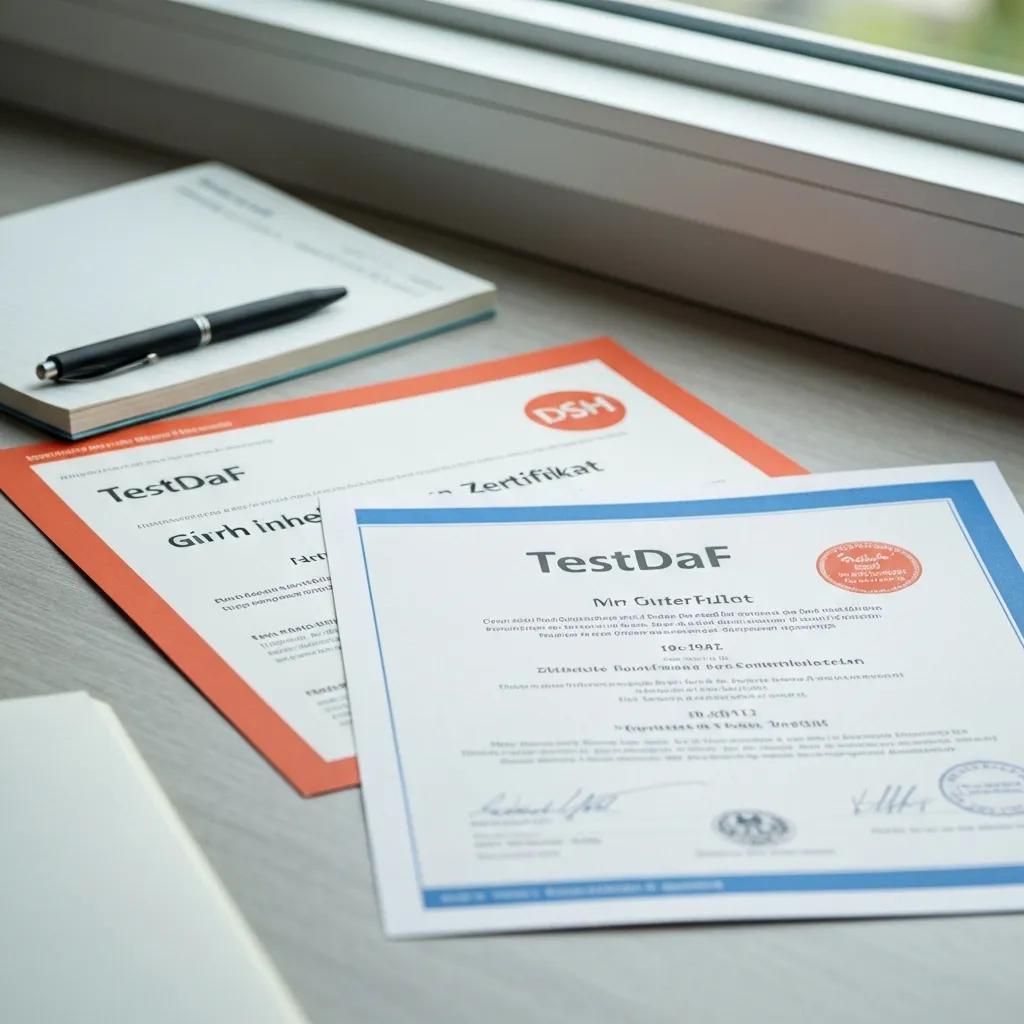
German universities accept a set of standard language certificates that map to CEFR levels and test components; choosing the right certificate depends on program type and university preference. The most common accepted certificates are TestDaF, DSH, Goethe-Zertifikat, telc Deutsch C1 Hochschule, and DSD II, each differing in format, scoring, and typical acceptance contexts. Below is a compact comparison table to help you see format, CEFR equivalence, and acceptance notes before exploring exam details and preparation tips.
| Certificate / Test | Format & Components | Typical Score / CEFR & University Acceptance |
|---|---|---|
| TestDaF | Four sections (reading, listening, writing, speaking) taken at authorized centres | TDN 4–5 typically maps to B2–C1; widely accepted by universities for degree admission |
| DSH | University-run exam with written and oral parts, focusing on academic language | DSH-2/DSH-3 correspond to B2–C1; often required or preferred by individual universities |
| Goethe-Zertifikat C1 | Standardized external exam with four skill sections | C1 certificate directly maps to C1 and is accepted by many institutions for C1 requirement |
| telc Deutsch C1 Hochschule | Academic-oriented test with university-style tasks | Designed for degree admission; accepted by many technical universities and Fachhochschulen |
| DSD II | School-leaver certificate tied to German school exams | Equivalent to B2–C1 for applicants from German-language schools; accepted in specific pathways |
This table shows which certificates best match university expectations and clarifies why you should confirm a particular program's preferred tests. The next subsection explains the core features of each key exam to guide your test selection and preparation.
What Are the Key German Language Exams: TestDaF, DSH, Goethe-Zertifikat, telc, and DSD II?
Each major German exam targets different applicant needs: TestDaF is internationally available and standardized, DSH is institution-specific and often administered by universities, Goethe certificates suit broad language qualifications, telc C1 Hochschule is tailored for academic study, and DSD II is for school-based qualifications. TestDaF uses TDN scores (3–5) across four components; many universities specify a minimum TDN level. DSH mixes written academic tasks and an oral exam and is graded DSH-1 to DSH-3. Goethe and telc are modular, externally validated tests that map cleanly to CEFR levels and are straightforward to list on applications. DSD II is typically relevant for applicants from German schools and demonstrates upper-secondary German competence. Knowing these distinctions helps you choose test dates, plan preparation, and align your certificate with university requirements.
How Do TestDaF and DSH Requirements Differ Across Universities?
TestDaF and DSH are often treated as equivalent but universities vary in how they translate scores to admission requirements and specific faculties may demand higher thresholds. A common baseline is TestDaF TDN 4 in all four sections or DSH-2, which roughly equates to B2/C1 readiness; however, competitive fields like medicine or law may require TDN 5 or DSH-3 to demonstrate stronger academic language ability. Verification steps include checking the faculty admissions page or contacting the admissions office and using uni-assist where applicable to confirm credential evaluation. When in doubt, applicants should aim for the higher threshold and prepare for retakes; the next section addresses English requirements for programs taught in English.
DSH and TestDaF: Key for German University Admission and Academic Success
DSH or TestDaF • entrance into any German state university • system as well as achievement of positive study results •
Content, 1985
What Are the English Language Requirements for Studying in Germany?

Many degree programs in Germany are offered in English, particularly at the master's and PhD levels, and universities accept a range of English proficiency tests with defined minimums tied to program level. Accepted tests commonly include IELTS Academic, TOEFL iBT, Cambridge English (e.g., C1 Advanced), and PTE Academic; each test measures the four core skills and maps to university score expectations. Typical minimums for master's programs fall in the IELTS 6.5–7.0 and TOEFL 80–95 ranges, but precise thresholds depend on program competitiveness and discipline. Below is a concise table comparing English tests, their typical minimum score ranges, and program-level notes to help you decide which test best fits your application timeline and strengths.
| English Test | Minimum Score Range | Typical Program Level / Exceptions |
|---|---|---|
| IELTS Academic | 6.5 – 7.0 | Common for master's programs; some research degrees ask for 7.0+ |
| TOEFL iBT | 80 – 95 | Widely accepted; technical programs may request higher sub-scores |
| Cambridge C1/C2 (CAE/CPE) | C1 – C2 | Recognized as proof of advanced proficiency; sometimes preferred over modular scores |
| PTE Academic | 60 – 70+ | Increasingly accepted; check specific faculty minimums and validity periods |
This table clarifies relative expectations and shows that English-taught programs offer flexible test options; the following subsection lists the primary tests and institutional preferences to guide registration choices.
Which English Proficiency Tests Do German Universities Accept?
German universities accept IELTS Academic, TOEFL iBT, Cambridge English qualifications (C1 Advanced and C2 Proficiency), and PTE Academic as primary proof of English proficiency; test selection depends on program preference and regional familiarity. IELTS Academic is commonly requested for programs with UK-style assessment, while TOEFL is favored by institutions with a North American orientation; Cambridge certificates demonstrate stable CEFR-level proficiency. Some universities accept alternative documentation such as a prior degree taught fully in English, but they will require official transcripts and an explicit statement of language of instruction. Confirm acceptance windows (validity periods) and required minimum component scores when planning test dates and documentation.
What Are the Minimum English Test Scores Needed for Admission?
Typical minimum scores vary by degree level: bachelor's programs that are English-taught may accept IELTS 6.0–6.5 or TOEFL 70–80, while master's programs often require IELTS 6.5–7.0 or TOEFL 80–95, and PhD programs usually expect the higher end or equivalent certification. Competitive or research-heavy programs can raise thresholds and emphasize strong writing and speaking sub-scores. If you lack a formal test result but have completed a prior degree taught in English, many universities will accept that as evidence provided you supply official documentation. The next section explains how Studienkolleg and preparatory programs can bridge gaps from lower starting levels to the required CEFR targets.
TestDaF Exam: Assessing Language Abilities for University Study in Germany
Do students not admitted to university study on the basis of TestDaF exhibit the language abilities necessary for success? Do students not admitted to university study on the basis of TestDaF exhibit the language abilities necessary for success?
Test review: TestDaF, J Norris, 2018
How Can Studienkolleg and Preparatory Language Courses Help Meet Language Requirements?
Studienkolleg and intensive preparatory language programs offer structured pathways to reach the CEFR thresholds universities require, combining language instruction with subject-specific academic preparation. Studienkolleg is a formal, semester-based foundation program that prepares international students for the university assessment test and usually expects at least B1–B2 on entry, with successful completion equating to readiness for degree studies. Intensive private language courses and university propaedeutic programs focus on accelerated skill-building to reach B2 or C1 and vary in duration depending on starting level and study intensity. The table below maps typical starting levels to recommended pathways and estimated timelines so you can pick a realistic plan based on your present proficiency.
| Starting Level | Recommended Pathway | Estimated Time to Reach B2 / C1 & Course Types |
|---|---|---|
| A0–A1 | Intensive language immersion + long-term course | 9–18 months to B2 with full-time intensive courses or 18–30 months to C1 via staged learning |
| A2 | Intensive courses or blended online + summer immersion | 6–12 months to B2; 12–18 months to C1 with targeted exam prep |
| B1 | Short intensive or university prep + exam-focused modules | 3–6 months to B2; 6–9 months to C1 with focused writing and academic vocabulary training |
This timeline table helps set realistic expectations for course selection and scheduling; the following subsections explain Studienkolleg specifics and options for intensive preparation, and how specialized admission services can assist placement.
What Is a Studienkolleg and What Language Levels Does It Require?
A Studienkolleg is a university-preparatory college for international students whose secondary education does not directly qualify them for German university admission; it combines subject modules with language and study skills training. Typical entry requires functional German (often B1 to B2) because classes move quickly and include academic content in German; successful completion culminates in an assessment test that qualifies you for degree programs in the chosen subject cluster. Types of Studienkolleg include technical and medical preparatory tracks among others, aligning with later faculty choice; entry requirements and structure vary by institution, so early planning and language assessment are essential. After explaining Studienkolleg, the next subsection covers intensive language options outside the formal Studienkolleg route.
Which Intensive Language and Propaedeutic Programs Prepare Students for University?
Intensive language programs range from full-time language schools offering 20–30 hours weekly to university propaedeutic modules that combine language with subject-specific instruction and exam practice. Online blended courses can accelerate vocabulary and grammar consolidation while local immersion and tandem speaking practice improve oral fluency, which is key for oral exam components. When choosing a program, prioritize composite curricula that include academic writing, lecture comprehension, and specialized vocabulary for your field; this ensures readiness for both the language test and academic expectations. For students needing placement help and tailored plans, the Comprehensive Admission Program at StudyInFocus matches applicants with appropriate Studienkolleg or intensive language options and supports enrollment logistics.
Who Is Exempt from Language Tests and What Are Alternative Admission Options?
Certain applicants may be exempt from formal language test requirements, and universities provide alternative routes such as internal assessments or conditional admission that allow you to begin studies once you meet language conditions. Common exemptions include native speakers of the language of instruction and candidates who have previously completed a degree taught in the target language, provided they furnish official documentation proving the language of instruction. Conditional admission is a structured alternative where you receive an offer contingent on completing specified language modules within a deadline; this helps applicants progress while they finalize language proof. The next subsections enumerate exemption categories and explain how conditional admission functions in practice.
Which Students Are Exempt from German or English Language Tests?
Typical exemptions include applicants whose prior degrees were taught fully in the required language, native speakers, and graduates of recognized school systems that use the language of instruction; universities require certified proof such as transcripts or a formal letter from the institution verifying the language of instruction. Some programs accept waivers when applicants completed secondary education in the language or hold certain diplomas that implicitly demonstrate proficiency. Be prepared to submit certified translations and notarised documentation where requested; if documentary evidence is insufficient, the university may ask for an internal language assessment or require you to sit a local language test. Understanding documentation standards early prevents delays in application evaluation and visa procedures.
How Does Conditional Admission Work for Students Without Required Language Proficiency?
Conditional admission means the university issues an offer that depends on meeting specific language conditions by a set deadline, typically involving completing a language course, passing an internal exam, or submitting an accepted external certificate. The usual sequence is: receive conditional offer → enroll in an approved language course or Studienkolleg → submit proof of achieved level (certificate or internal test result) → final enrollment confirmation. Risks include missing deadlines or failing to meet the specified level, which can void the offer; to mitigate this, plan accelerated courses, retake strategies, and communicate with admissions. Many applicants use external agency support to manage timelines and ensure documentation is correctly presented to avoid administrative setbacks.
How Does Language Proficiency Affect Visa and Residence Permit Applications for International Students?
Language proficiency primarily affects visa and residence permit processes through the documentation universities provide and any additional evidence consulates may request; a confirmed admission that includes language proof usually satisfies visa requirements, while missing language evidence can delay application processing. Visa authorities generally rely on the admission letter and submitted certificates as part of the package demonstrating readiness to study; in special cases, consulates may request explicit language proof or further clarification about conditional admission terms. StudyInFocus supports students by verifying language documentation formats, coordinating with universities to ensure acceptance criteria are clearly stated in admission letters, and advising on timelines for submitting certificates to consulates to reduce visa-related delays.
What Are the Language Requirements for Student Visa Approval in Germany?
For most student visa applications, the primary language-related document is the university admission letter, which should state the language of instruction and any conditions related to language proficiency; consulates typically accept this letter along with copies of language certificates as evidence. Additional language proof is usually only required if the admission letter itself does not clarify language readiness or when conditional admission is in place and the consulate needs assurance you can meet conditions. Applicants should prepare certified copies of certificates and translations when requested, and maintain clear records of course enrolment if completing language training after arrival. Ensuring your admission package clearly shows language compliance reduces the chance of supplementary requests from visa authorities.
How Does StudyInFocus Support Language Preparation and Visa Processes?
StudyInFocus provides a structured pathway that begins with an initial language assessment and a personalized study plan mapping your starting level to target CEFR outcomes, then places you into suitable Studienkolleg or intensive language options while managing application timelines. The agency liaises directly with German universities to clarify certificate acceptance and conditional offer requirements, prepares documentation packages that itemize language proof for visa submissions, and offers post-arrival assistance to ensure you transition smoothly into on-campus language support if necessary. StudyInFocus also offers a re-application guarantee within their Comprehensive Admission Program and personalized guidance for complex cases, including applicants with no prior German; this service model addresses common pain points in language testing, placement, and visa documentation.
- Key documents to prepare for visa submission: Admission letter stating language of instruction and any conditions.Certified copies of language certificates or proof of enrolment in approved language courses.Official translations where required.
- Common steps StudyInFocus assists with: Initial language assessment and tailored course placement.Direct communications with universities to verify acceptance criteria.Compilation of documentation for visa submission and post-arrival support.
These steps reduce administrative friction and help applicants meet both academic and immigration requirements on schedule.
Остались вопросы? Запишитесь на Консультацию!
Получите ответы на ваши вопросы на индивидуальной онлайн консультации с нашим специалистом
Записаться!